
This guide explains the main length/distance units in both systems, how to convert between them, where people usually go wrong and why a calculator can save time. It is written in plain UK English and is aimed at anyone who wants a practical explanation rather than a technical maths lesson. If you work with measurements regularly, or even just occasionally, it helps to know how to move confidently between metric and imperial without second-guessing yourself.
What Length/Distance Conversion Means
The same applies in imperial units. 12 inches is the same as 1 foot. 3 feet is the same as 1 yard. 1,760 yards is the same as 1 mile. The measurement itself does not change, only the way it is expressed. That sounds simple and in principle it is, but the challenge comes from remembering the correct conversion factors and using them in the right direction.
This matters because people often work in mixed-unit environments. A plan might be written in metres, a product spec might use inches, a property listing might refer to feet and a road distance might be given in miles. If you cannot convert quickly and accurately, it becomes harder to compare figures, estimate sizes or avoid mistakes.
Length/distance conversion is also useful because it helps bridge the gap between systems. The UK uses metric in many settings, but imperial still appears in everyday speech, property descriptions, DIY and some product specifications. Being able to move comfortably between the two gives you more confidence when reading measurements and making decisions.
Metric Units
The basic relationships are:
– 10 millimetres = 1 centimetre
– 100 centimetres = 1 metre
– 1,000 metres = 1 kilometre
That means converting within metric usually involves multiplying or dividing by 10, 100 or 1,000. If you move from millimetres to centimetres, divide by 10. If you move from centimetres to metres, divide by 100. If you move from metres to kilometres, divide by 1,000. The same logic works in reverse if you are converting from larger to smaller units.
One reason metric is so useful is that the relationships stay consistent. You do not need to memorise a different ratio for every unit pair. Once you understand the decimal structure, the whole system becomes much easier to use. That is why metric is so common in science, engineering, construction and many everyday measurements.
There is also a useful practical habit to build. When you see a metric number, you should immediately think about where the decimal point needs to move. A conversion from millimetres to metres is mostly about re-scaling the number rather than doing a complex calculation. That makes metric very efficient once you are used to it.
Imperial Units
The key imperial relationships are:
– 12 inches = 1 foot
– 3 feet = 1 yard
– 1,760 yards = 1 mile
These ratios are simple enough on their own, but they become less intuitive when you move between imperial and metric. That is because imperial is not built around clean decimal steps. A foot is not 10 inches. A yard is not 10 feet. A mile is not 10,000 yards. The conversions are fixed, but they require a bit more memorisation.
This is why many people find imperial harder to estimate mentally. You can often guess metric conversions fairly quickly because the logic is regular. Imperial conversions are still manageable, but they rely more on remembering specific values. Once those values are in your head, the system becomes much less awkward.
Imperial is still useful because many people understand it instinctively for everyday distances. Feet can feel more natural than metres in certain contexts and miles remain the standard unit for road travel in the UK. So even if metric is more mathematically tidy, imperial is still part of everyday measurement language.
The Key Conversion Values
The most useful values are:
– 1 inch = 2.54 centimetres
– 1 foot = 0.3048 metres
– 1 yard = 0.9144 metres
– 1 mile = 1.609344 kilometres
– 1 metre = 3.28084 feet
– 1 metre = 39.3701 inches
– 1 kilometre = 0.621371 miles
These values are the backbone of most length/distance conversions. If you know them, or at least know the ones you use most often, you can convert almost anything with confidence. You do not necessarily need to memorise every figure to six decimal places, but it helps to know the common approximations.
For most day-to-day work, people round some of these values. For example, 1 metre is often treated as roughly 3.28 feet and 1 inch is often treated as 2.54 centimetres exactly. The important thing is to be clear about whether you need a precise answer or an approximation. In casual settings, a close estimate may be fine. In technical or commercial contexts, precision matters more.
This is one reason conversion tools are so useful. They remove the need to remember every exact multiplier and reduce the chance of accidental error. But even when using a calculator, understanding these core values helps you spot whether a result looks sensible.
Metric to Imperial Conversions
A simple example is converting metres to feet. Since 1 metre is approximately 3.28084 feet, you multiply the number of metres by 3.28084. So 2 metres is about 6.56168 feet. If you round that for everyday use, you might say 2 metres is about 6.56 feet.
If you want to convert centimetres to inches, you use the relationship that 1 inch is 2.54 centimetres. That means centimetres divided by 2.54 gives you inches. So 10 centimetres is about 3.94 inches. Again, the exact value depends on how much rounding you want to use.
For larger metric values, the same principle applies. To convert kilometres to miles, multiply by 0.621371. So 5 kilometres is about 3.11 miles. That is why road distances are often easy to estimate when moving between systems, even if the numbers are not identical.
Metric to imperial conversions can feel awkward at first because the numbers are not as neat as metric-to-metric conversions. But once you know the main factors, the process becomes predictable. The unit changes, the length stays the same and the calculation is just a matter of applying the right ratio.
Imperial to Metric Conversions
If you are converting inches to centimetres, multiply by 2.54. So 12 inches is 30.48 centimetres. If you are converting feet to metres, multiply by 0.3048. So 10 feet is 3.048 metres. If you are converting miles to kilometres, multiply by 1.609344. So 3 miles is about 4.828 kilometres.
The reason this direction matters is that people often accidentally use the wrong factor. If you start from the wrong unit pair or multiply instead of divide when you should divide, the answer can be very wrong. This is especially common when switching between systems quickly.
Imperial to metric often feels more natural in the UK because metric is the cleaner target unit for many modern tasks. A room measured in feet can be converted to metres for planning. A person’s height in feet and inches can be converted to centimetres. A road journey in miles can be translated into kilometres. These are all common real-world uses.
If you only remember one thing about imperial to metric, remember that the conversion factor must match the unit pair. Inches do not convert using the same factor as feet. Feet do not convert using the same factor as miles. Each pair has its own fixed relationship.
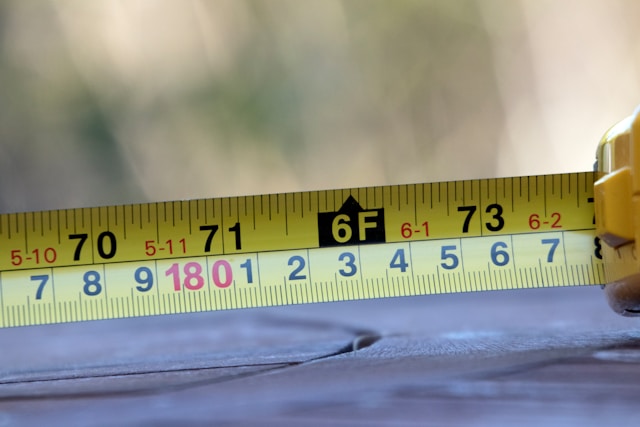
Inches, Feet and Yards in Practice
The core relationships are straightforward:
– 12 inches = 1 foot
– 3 feet = 1 yard
– 36 inches = 1 yard
That means you can move within imperial by grouping or ungrouping the units. For example, 30 inches is 2 feet 6 inches. 5 feet is 1 yard 2 feet. 7 feet 9 inches can also be written as a combination of feet and inches rather than one single number.
This is useful because imperial is often used in mixed format. A person’s height may be given as 5 feet 11 inches. A room length might be 12 feet 4 inches. A garden size might be described in yards rather than feet. In these cases, conversion is not just about changing the unit. It is about presenting the measurement in the format that makes most sense.
When you need to convert mixed imperial measurements to metric, the easiest method is usually to convert everything into one imperial base unit first, then convert to metric. For example, if you have feet and inches, convert the inches into a fraction of a foot or convert the full measurement into inches before moving to centimetres or metres. That reduces confusion and helps avoid double counting.
Millimetres and Centimetres in Practice
A centimetre is one hundredth of a metre and a millimetre is one thousandth of a metre. Since 10 millimetres make 1 centimetre, it is easy to move between them. If you have 45 millimetres, that is 4.5 centimetres. If you have 8.3 centimetres, that is 83 millimetres.
This simple decimal structure is one of the big strengths of metric. You do not need to remember a weird ratio for every conversion. You just move the decimal point and keep track of the scale. That is one reason metric is preferred in technical drawing and many other professional contexts.
Centimetres are often used for moderate-sized everyday objects, while millimetres are useful for more detailed or precise measurements. For example, a TV screen might be measured in centimetres, while a sheet thickness or engineering tolerance might be measured in millimetres. Knowing how to switch between them is a basic but valuable skill.
If you are moving from centimetres to imperial, the useful anchor point is still 2.54 centimetres per inch. That gives you a reliable bridge between the two systems.
Metres, Feet and Kilometres
The metre is the central unit in the metric system. If you know the value in metres, you can easily scale it up to kilometres or down to centimetres and millimetres. In imperial, the foot is often the most convenient unit for medium-sized distances, while the mile is the common large-distance unit for roads.
Useful comparisons include:
– 1 metre = 3.28084 feet
– 1 foot = 0.3048 metres
– 1 kilometre = 0.621371 miles
– 1 mile = 1.609344 kilometres
These are especially helpful when comparing property dimensions, running distances, road travel and room sizes. For example, if a room is 4 metres long, that is about 13.12 feet. If a drive is 10 miles long, that is about 16.09 kilometres.
For many people, metres and feet are the most common bridge between systems. If you can convert those comfortably, the rest of the units become easier to place in context.
How to Avoid Common Mistakes
Another common mistake is confusing similar units. Inches and feet are not the same. Centimetres and metres are not the same. A number that looks reasonable in one unit may be wildly wrong in another. That is why you should always check the unit as carefully as the number.
Rounding too early is another issue. If you round in the middle of a calculation, the final result may drift further from the true value than you realise. For casual use that may not matter much, but for design, construction or technical work it can matter a lot.
A further mistake is forgetting that imperial and metric do not convert in neat whole numbers most of the time. A metre is not exactly 3 feet. A mile is not exactly 1.6 kilometres. If you rely on rough memory too much, you can end up with a result that is close enough to sound right but still wrong enough to cause problems.
The safest habit is to check the unit pair, choose the correct factor and keep rounding to the end.
Sign Up To Our Newsletter
Why Metric Feels Easier
This simplicity makes metric very effective for calculations, engineering, science and many everyday tasks. If you know the number of metres, converting to kilometres or centimetres is simple. If you know the number of millimetres, converting to metres is straightforward. The structure is consistent across the whole system.
Imperial is not impossible, but it is more fragmented. There are 12 inches in a foot, 3 feet in a yard, and 1,760 yards in a mile. Those are all fixed and workable, but they do not follow one clean decimal pattern. That means imperial often requires more memorisation and more care.
Even so, imperial still has a place because many people are familiar with it and it remains useful in everyday speech. In the UK, you may hear both systems used in the same conversation. That is exactly why understanding both is valuable.
Where Length/Distance Conversion is Used
In property, room sizes may be listed in metres, but people may still talk in feet or yards. In DIY, materials may be sold with metric dimensions, while older tools or plans may use imperial. In sports, running distances may be measured in kilometres for training but miles for route familiarity. In product design, one market may expect metric, while another may expect imperial.
That is why a length/distance conversion calculator is useful. It saves time, but more importantly, it reduces the risk of comparison errors. If you are buying something or planning something based on dimensions, a small mistake can become an expensive one.
The practical value of conversion knowledge is not just mathematical. It helps you understand information better and make cleaner decisions.
Simple Examples
If you want to convert 50 centimetres into inches, divide by 2.54. That gives you about 19.69 inches.
If you want to convert 6 feet into metres, multiply by 0.3048. That gives you 1.8288 metres.
If you want to convert 2 metres into feet, multiply by 3.28084. That gives you about 6.56 feet.
If you want to convert 5 miles into kilometres, multiply by 1.609344. That gives you about 8.05 kilometres.
If you want to convert 120 millimetres into centimetres, divide by 10. That gives you 12 centimetres.
If you want to convert 2,000 metres into kilometres, divide by 1,000. That gives you 2 kilometres.
These examples show the two main patterns. Metric to metric is usually a power-of-ten move. Metric to imperial, or imperial to metric, uses a fixed conversion factor. Once you see the difference clearly, the whole topic becomes easier to handle.
Why Calculators Help
Calculators also reduce mistakes. If you are under time pressure, it is easy to use the wrong ratio, round too early or misread a unit. A calculator helps standardise the process. That is useful whether you are measuring a room, comparing product sizes, planning a route or checking a technical specification.
For many users, the benefit is confidence. When a calculator returns the converted value, you can focus on the decision rather than the arithmetic. That is particularly helpful in practical settings where accuracy matters more than doing the sum by hand.
Frequently Asked Questions
The easiest way is to know the main conversion factors and use the right direction. Metric to metric is usually a matter of moving the decimal point, while metric and imperial use fixed values.
There are 2.54 centimetres in 1 inch. This is one of the most useful conversion values to remember.
There are about 3.28084 feet in 1 metre. A rough everyday estimate is 3.28 feet.
1 mile is 1.609344 kilometres, which is 1,609.344 metres.
Metric feels easier because it is based on decimal steps of 10, 100 and 1,000. That makes the relationships between units more regular.
Yes, for informal use you often can. But if accuracy matters, especially in construction, design, or technical work, you should use the correct conversion factor.
The biggest mistake is using the wrong factor or mixing up whether you need to multiply or divide. That can completely change the answer.
Conclusion
The most important thing is to be clear about what you are converting and in which direction. If you know the right conversion factor, the rest is usually straightforward. If you are starting from metric, use the metric-to-imperial relationship. If you are starting from imperial, use the imperial-to-metric relationship. If you are staying within metric, just move by powers of ten.
This topic matters because measurements appear everywhere and not always in the unit you would prefer. Being able to switch between systems quickly helps with everyday understanding, practical decisions and avoiding costly mistakes. A good length/distance conversion calculator is useful, but the underlying logic is even more valuable because it gives you confidence no matter where the measurement came from.